


On this page you will find
information about
STUDYING IN DENMARK
Which topic are you
interested in?

Pre-arrival
-
This section focuses on regular higher education (HE) for adults (17+). Find information about
schooling for children and youth here.
life-long-learning, AMU, vocational degrees, and part-time courses at university level here.
In Denmark, the vast majority of HE degrees programmes follows the Bologna Process, meaning that they are structured into bachelor’s and master’s degrees:
Bachelor’s degree: 3 years, 180 ECTS
Master’s degree: 2 years, 120 ECTS
In addition to these programmes, in Denmark you will find:
Professional Bachelor’s degrees (“Professionsbachelor”), 3 to 4,5 years, 180-240 ECTS
Top-up degrees, 1,5 years, 90 ECTS (Can be taken as an extension to an academy profession programme (“erhversakademiuddannelse”), leading to a BA/BSc degree.
Master’s degrees for working professionals (“Erhvervskandidat”), 4 years, 120 ECTS, 50% study, 50% relevant work. Read more here (in Danish).
-
In Denmark there is a coordinated admission for undergraduate higher education programmes university bachelor programmes, professional bachelor programmes and academy profession programmes.
This means that you can apply digitally for admission to up to 8 different educational programmes, but you will not get an offer for more than one programme.
Admission requirement can be found on optagelse.dk and the respective university’s/college’s website.
Applications are sent in via optagelse.dk.
You can find more general information and guidance on admission to a higher education programme in Denmark here.
-
If you are coming to Denmark with e.g., a bachelor’s degree from another country, it might be beneficial or necessary to request an official recognition of your degree from the Danish Agency for Higher Education and Science.
If in doubt, please always contact a student advisor at the educational institution you are applying to inquire about the suitability of your qualification and whether an official recognition will be necessary.
You can read more about the overall benefits of a recognition and start the process here.
-
All international students (full degree and exchange) studying in Denmark are obliged to either hold an EU residence document or a residence permit (citizens of Nordic countries are exempt).
Apply for an EU residence document as a student
Apply for a residence and work permit as a student (non-EU)
Note that residence permits for students (non-EU) are issued without or with a limited work permit, allowing you to work a certain number of hours. The number of hours you are allowed to work while holding a residence permit as a student is dependent on the exact type of permit you hold and the time of the year (term/semester vs summer).
You can find all details under the respective residence permit here.
-
Practicalities
-
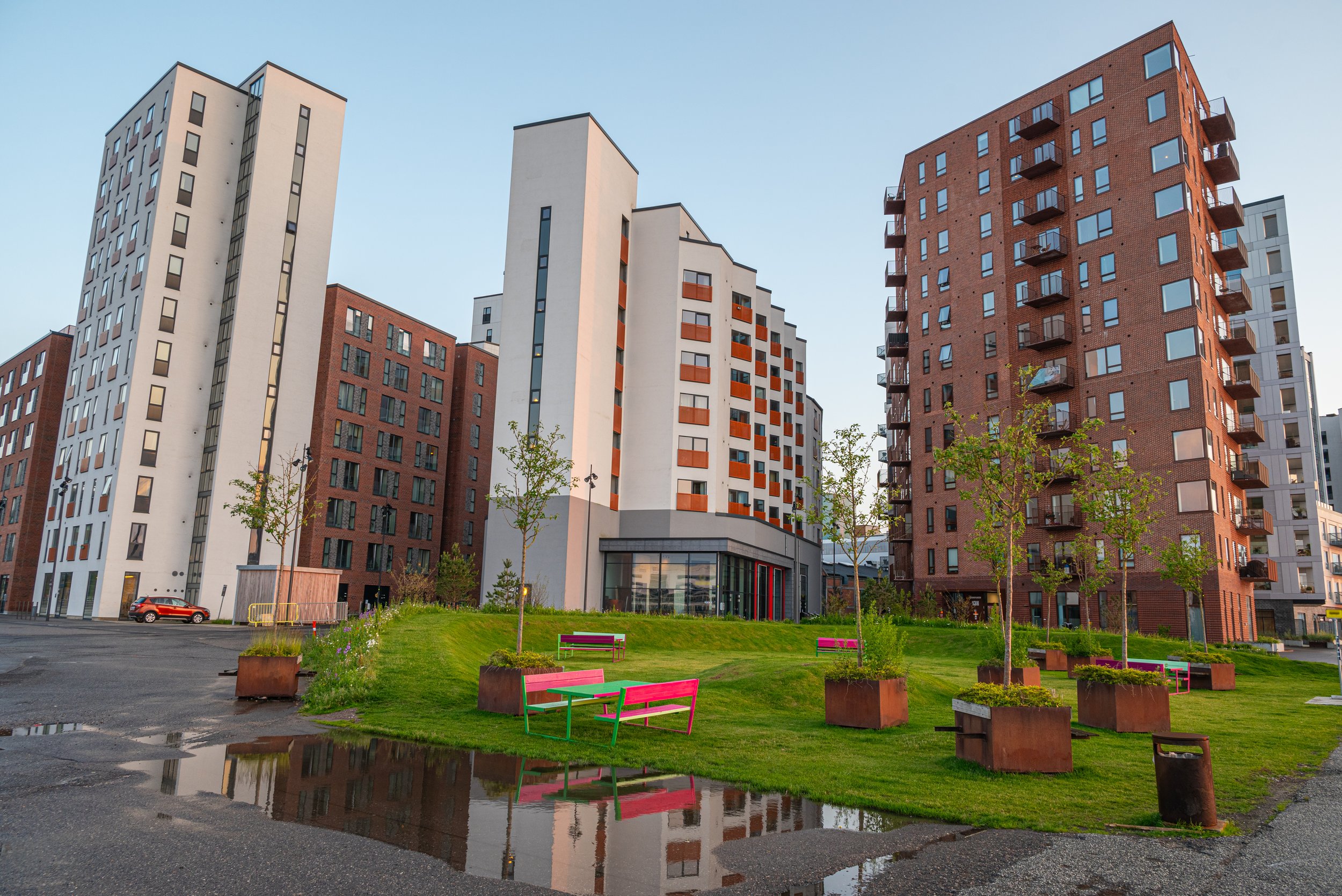
As an international student, you have various options when it comes to accommodation:
AAU International Accommodation Office (IAO)
… offers a limited number of furnished rooms and small apartments to international students at AAU. We recommend that you apply for housing through the IAO as early as possible – once you’ve been accepted at AAU. All rental agreements through the IAO are fixed term for 6 months (from 01. Aug. or 01. Feb.), with the possibility to extend each semester. Shorter periods cannot be offered.
… is the association that manages the assignment of youth and student housing (incl. dorms) in and around Aalborg. Studiebolig’s apartments are unfurnished (maintenance & electricity are included). You can apply up to one year prior to the start of your studies.
Kollegie/Kollegium (“dorm”)
Student dorms usually consist of private rooms (incl. private bathrooms) and shared kitchens and offer relatively cheap housing for students. Some dorms offer rooms with private kitchens and/or apartments for students with children. Most dorms, especially in popular locations, have waiting lists of 1 to ca. 12 months.
Different dorms are administered by different bodies, which leads to slightly different application procedures:
Municipal dorms application via Studiebolig Aalborg
Self-owned dorms application via the respective dorm’s website (owned by e.g., funds or organisations)
Privately owned dorms often newer and more modern, therefore often pricier (owned/driven by private companies)
Private flats and rooms in shared flats
Many students choose to share a regular rental flat with one or more flat mates. For more information on how and where to find regular flats and rooms for rent, go here.
Aalborg Municipality offers a housing guarantee for new students, starting education in the fall semester. The guarantee means that you get in front of everybody else in the queue and will be offered a random youth accommodation and with a moving in date from August 1st to December 15th.
It is possible to sign up for the housing guarantee every year from August 1st to August 31st.
Please note! If you consider using the housing guarantee, which will be open for subscription from July 1st, then you must not have declined or ignored an offer for accommodation for takeover from August 1 or later.
Through the startup housing scheme, you will have a roof over your head for the start of your studies, if you have not been able to secure housing through the regular waiting lists, the Housing Guarantee or other means.
To use the Startup Housing solution, you must meet and comply with all the conditions in the guidance regarding The Startup Housing. It is your responsibility to familiarize yourself thoroughly with all the rules and conditions.
-
If you are intending to stay in Denmark after the completion of your studies, we highly recommend that you start your language learning journey as early as possible.
This will not only help you in your job search but make your daily life in North Denmark just a bit easier.
Furthermore, having obtained a certain level of Danish is one of the requirements for receiving dagpenge (unemployment benefits) as a recent graduate.
Keep in mind that the business language of most companies in North Denmark is, contrary to in the capital region, Danish.
Learning Danish can therefore be a vital step towards employment and/or your dream internship – (almost) regardless of which field you are going into.
Like all international citizens, after registering your address and receiving at CPR-number, you will receive a referral to Danish classes for foreigners from your municipality (in Digital Post). Once you have received this, you can sign up to classes.
At Aalborg University the school “HF&VUC NORD” offers the official Danish language education to students, employees and spouses – on campus.
Read more on the school’s website.
If you want to attend classes at the sprogcenter in Aalborg Vestby instead or live in another municipality and would prefer attending classes there, you can always choose to sign up to the respective sprogcenter.
Students and staff at UCN: Please sign up to the municipal language center (sprogcenter) in the municipality that you live or work in.
-
Many unions offer student memberships for free or at a heavily reduced price.
Most unions offer specialised events, networks, and services tailored to students’ and recent graduates’ interests and needs.
These services can reach from e.g., budget planner and CV tools to personalised career guidance.
Another benefit of being a member of a union when graduating is that they can help you with assessing the legitimacy of employment contracts and your salary negotiations – something many recent graduates struggle with.
Note that, being a member of a union alone does not entitle you to receiving unemployment benefits. For this, you need to be a member of an a-kasse, too.
Below, we have collected guidance on unemployment benefits as an international graduate.
Even if you are not entitled to unemployment benefits (dagpenge) joining a union can be beneficial.
-
You may be entitled to unemployment benefits based on a completed education.
If certain conditions apply, you, as a newly qualified person, have the right to unemployment benefits from 1 month after you have completed your studies, for instance a bachelor’s or master’s degree programme.
Other types of education may entitle you to unemployment benefits.
To qualify for unemployment benefits as a newly qualified international graduate, you must fulfil one of the following conditions:
You have passed the Danish language proficiency test ‘Prøve i Dansk 2’ with a mark of at least 02 on the 7-point grading scale or a Danish language proficiency test at an equivalent or higher level.
You have had at least 600 paid hours as full-time insured and 400 paid hours as part-time insured for 12 months within the last 24 months.
You must join an unemployment insurance fund no later than 2 weeks after concluding your education (or prior to graduating).
Your unemployment insurance fund can inform you further about the conditions for entitlement to unemployment benefits.
-
Residence under Danish Aliens Act (non-EU):
Please inform yourself about how graduating effects the validity of your residence permit before graduating. Some student residence permits include a residence permit for job seeking for after your graduation (6 months or 3 years).
If you have not been granted a 6-month or a 3-year job seeking permit along with your residence permit, you can apply for it when you finish your educational programme.
You can find the conditions of your student residence permit here.
If applicable, you can apply for a job seekers permit here.
With questions about your specific case or e.g., your family members’ residence permits, please reach out to SIRI.
Residence under EU regulations:
If you hold an EU residence document as a student and are graduating from your study programme in Denmark, you need to inform SIRI about your change of grounds of residence.
You can do so on this page.
If you are receiving dagpenge as a graduate, you can apply for a residence paper as a person with sufficient funds for self-support.
You can remain living in Denmark as long as you fulfil the requirements of your current EU residence paper.
You need to inform SIRI every time your grounds of residence change.
Local contacts
-
Aalborg University is one of Denmark’s 8 universities and has campuses in Aalborg, Copenhagen and Esbjerg.
AAU offers a wide variety of degree programmes on Bachelor, Master, and PhD level. Please note that only selected programmes have English as their primary teaching language.
AAU admissions (degree students)
-
The University College North Denmark (UCN) is one of 6 university colleges (“professionshøjskoler”) in Denmark and has campuses in Aalborg, Hjørring, Frederikshavn, and Thisted.
UCN offers vocational educations (“erhversuddannelse”), academy professional programmes (“erhversakademiuddannelse”), Professional Bachelor’s degrees, and Top-up degrees.
Please note that the main teaching language at UCN is Danish. The school does offer a variety of courses taught in English, which are open to international exchange students.
For guest and exchange students
UCN International Office: international@ucn.dk
-
The Royal Academy of Music (Det Jyske Musikkonservatorium), RAMA, is based in Aalborg, Aarhus, and Holsterbro and is one of Denmark’s 9 specialised/artistic higher education institutions.
RAMA offers a wide range of programmes (Bachelor, Master, Advanced Postgrad. Diploma) within its three main areas: jazz/pop, classical, and electronic, composition and songwriting.
Read more about the academy’s programmes, admission requirements and auditions on RAMA’s website.

Finances & career development
-
SU translates to “Statens Uddannelsesstøtte” (State Educational Grant) and is economic aid to cover living expenses for (degree) students at youth and higher educations in Denmark.
In order to receive SU as an international student, you need to “obtain equal status with Danish citizens”. You can apply for equal status under the Danish rule or the EU rule – depending on your individual situation.
SU does not have to be paid back (unless you’ve received too much).
If you are considering applying for SU, please familiarize yourself with the rules and regulations.
You can find more general information links to the application here.
SU loan
Students receiving SU can apply for a supplementary state loan – SU lån. SU loans have to be repaid within 7 to 15 years; their interest rate is set by the Danish Parliament.
You can find more detailed information about SU loans here (in Danish).
Local SU-offices
UCN SU-office (in Danish)
RAMA (Aalborg) SU guidance (mail)
Dania Academy (Hobro) SU guidance (mail)
You can find further SU-offices and local contacts here.
-
Having a student job is not just good for your wallet. It can help you in your post-graduation job search and kick-start your career.
There are different types of student jobs. Generally speaking, they can be divided into three (overlapping) categories:
Jobs to generate an income
Jobs that align with your degree programme/professional interests
Jobs in research/at the university
Many students find their student job(s) on one of the popular online job search portals:
AAU Jobbank (requires login)
UCN Jobportal (requires login)
We highly recommend that you try to find a student job that aligns with what you are studying and/or the career you wish to pursue after graduation. It is not uncommon for companies to – if possible – offer regular employment to their former student workers.
Can’t find anything online? Try applying unsolicited to companies that interest you! Pitch your skills and background and who knows, maybe they just hadn’t realized that you’re exactly whom they need.
If in doubt about how to best adjust your CV and application to the Danish job market, join our next job search seminar.
Aspiring researchers
If you are looking to pursue a career in academia, it might be a good idea to try it out with a student assistant job in research.
You can find student (research) assistant jobs at AAU on its job website.
Other than keeping an eye on the job posting of AAU and other relevant employers in the region (e.g., private labs/R&D departments), we recommend that you are vocal about your desire to explore academia as a career.
Talk to your professors/lectors, let them know you’re interested in working with them.
Note that international students from outside the EU/EEA generally hold a limited work permit, restricting the number of hours you are allowed to work during and outside the semester. Go to this page to find out what rules apply to your residence permit.
-
If you are looking to land a job in North Denmark after graduation, it can be vital that you start searching for opportunities and building your network prior to graduation day.
Some ways to increase your chances of (quickly) finding a post-graduation job that aligns with your qualifications and interests are:
Having a relevant student job
Doing one or multiple relevant internships
Starting to learn Danish while studying
Attending job/career fairs and other networking events (e.g., hosted by your union or a-kasse)
Having a relevant volunteer job
Adjusting your application material (CV, letter) to the Danish job market and culture Get a kick-start to job search and applications in North Denmark at one of our job search seminars!
Realistic expectation management: For most graduates, finding their first “grown up job” after university/college is hard and can be disheartening. We recommend that you
talk to other – about the good, the bad, and the ugly
get honest feedback on your application material and job search strategy – not just from your mom
explore different paths that could lead to your dream job
find people that do what you want to do, connect with them and ask them how they got to where they are
Learn to translate your academic skills into real-world skills and competencies.
Being verbal about your job search and career goals: If no one knows you’re looking for a job, no one can help you.
Don’t be afraid to apply unsolicited and/or ask industry insiders for hints on where to apply/whom else to contact.
Remember to check whether you could be entitled to receiving graduate unemployment benefits (dagpenge) and what to do about your student residence permit/document once you’ve graduated in good time before you start stressing about your final exams and thesis.
-
Erasmus+
The Erasmus programme offers students from the EU/EEA and Switzerland the possibility to study abroad (2-12 months) as part of their higher education in their home countries.
For further information, please contact your home university.
Nordplus
If you are enrolled at a Nordic or Baltic higher education institution, Nordplus may offer a possibility to study in another Nordic or Baltic country as part of your degree.
For further information, contact your home university.
Erasmus Mundus/Joint Master Degree
The Erasmus Mundus programme is open to both EU/EEA and non-EU/EAA students. Through the Erasmus Mundus scheme you can apply for a scholarship to study specific Master's degree programmes.
See a list of Erasmus Mundus Master’s courses in Denmark here.
Danish government scholarships for highly qualified non-EU/EEA students
Danish universities receive a limited number of government scholarships each year to fund highly qualified full-degree students from non-EU/EEA countries and Switzerland. The scholarships are administered by the Danish universities, who each select the students, who are awarded with a scholarship.
Aalborg University grants approx. 15 of these scholarships each year. At AAU, the scholarship includes a tuition fee waiver and a monthly stipend.
All non-EU applicants are automatically considered when applying to a master’s programme. You can read more about tuition fees (non-EU students) and scholarships at AAU here.
Note that the monthly stipend will not necessarily sufficiently cover your monthly living costs in Denmark.
Fullbright Denmark (for citizens of the USA)
Offers scholarships to study or research in Denmark (incl. Greenland & The Faroe Islands) for up to one academic year. Read more on the website of Fullbright Denmark.
-
Many local business and service providers (e.g., hair salons) offer discounts for students that hold a valid student ID. Just ask and you might be able to save some money.
Furthermore, young people between 16 and 19 and students at SU-eligible educational institutions (e.g., AAU & UCN) can apply for a youth card for public transport. This card provides you with discounted travel between your address and your school as well as discounted tickets outside of your commuter zones.
You can read more about the youth card (ungdomskort) on the website of NT (Nordjyllands Trafikselskab) and on ungdomskort.dk (mostly in Danish).
-
Both AAU and UCN support and foster student entrepreneurship and go to great length to integrate solution-focused, entrepreneurial thinking and opportunities for business development into all degree programmes.
You can learn more about their offers and incubators under the following links:
UCN Startup (in Danish)
If you are studying at another institution in North Denmark, curious about their support and programmes for entrepreneurs but can’t find the right information/contact person, you are welcome to reach out to us.
Done with university but not done with developing your business (idea)? Reach out to StartUp Café Aalborg or the startup club/café/service in your municipality.
Free-time
-
You can find a lot of good tips and tricks about student life in Aalborg on Aalborg Kommunes website for students (in Danish).
Find out what to do in North Denmark on the weekends and during the semester breaks on Enjoy Nordjylland and Visit Denmark.
-
Aalborg Try Out runs every year from mid-August to mid-November and is for those between the ages of 15 and 25 – and/or students!
During that period, you can try everything from rugby, shooting and martial arts to ceramics, cooking and curling. The activities take place all week long in collaboration with local associations, who are ready to welcome both beginners and experienced people – including internationals.
So grab a friend – or come solo and meet new people – and maybe find your next hobby (or just a fun evening).You can find all activities here.
-
Volunteering plays a big role in Danish society. Taking up a volunteer role – even just for a few hours per week or month – can help you feeling more at home in Denmark, find (Danish) friends, improve your language skills and can even be a gateway to a paid job.
Many associations and clubs post their open volunteer positions on frivilligjob.dk/volunteering.dk.
If you can’t find what you’re looking for, feel very free to reach out to an association, club or organisation that interests you and ask whether they need new volunteers.
Most municipalities furthermore have a “frivilligcenter”, where you can get inspired about volunteering in your area and receive individual sparring. You can find the frivilligcenter closest to you here.
Useful Danish words:
forening – association
klub – club
idrætsforening/IF – sports club
træner – coach
frivillig – volunteer
frivilligt arbejde – volunteer work
frivilligcenter – “Center for Volunteers/Volunteering”

For PhD students
-
-
PAU is the association and network for all PhD students at the different faculties at Aalborg University. Being enrolled as a PhD student means that you automatically become a member of PAU.
The association is run by fellow PhD student volunteers and routinely organizes events to help and connect PhD students.
You can check an updated list of their upcoming events on Facebook.
-
Aalborg University offers career sparring for current PhD students where you can explore your strength and weaknesses and get inspired about career development within and outside of academia.
Current and past international PhD students, that are looking to find employment outside of academia are furthermore more than welcome to attend one of our job search seminars, where you will get insights into how to write and structure a non-academic CV.